Can't personalize beyond basic email and SMS
A quiz, a popup, and a product feed that all know the same visitor
Maestra Platform runs them from one profile, the all-in-one retention marketing platform for ecommerce brands, launched for you by a forward-deployed marketer.
Brands running on Maestra






The problem
Personalization stalls at the inbox
Email and SMS get most of the personalization budget, while the website, app, and ad creative stay generic. That split means a customer's browsing behavior can shape their next email but never shapes the page they are looking at right now, or the ad they see an hour later.
What we hear from brands
customer journeys are largely generic rather than personalized, according to an AV-equipment retailer
customers receive generic messages across channels, with no personalized onsite or email journeys, according to a heritage apparel brand
personalization across email and onsite is largely manual and not using rich quiz and browse data, according to a supplements brand
The new way
Let the CDP drive what the page shows
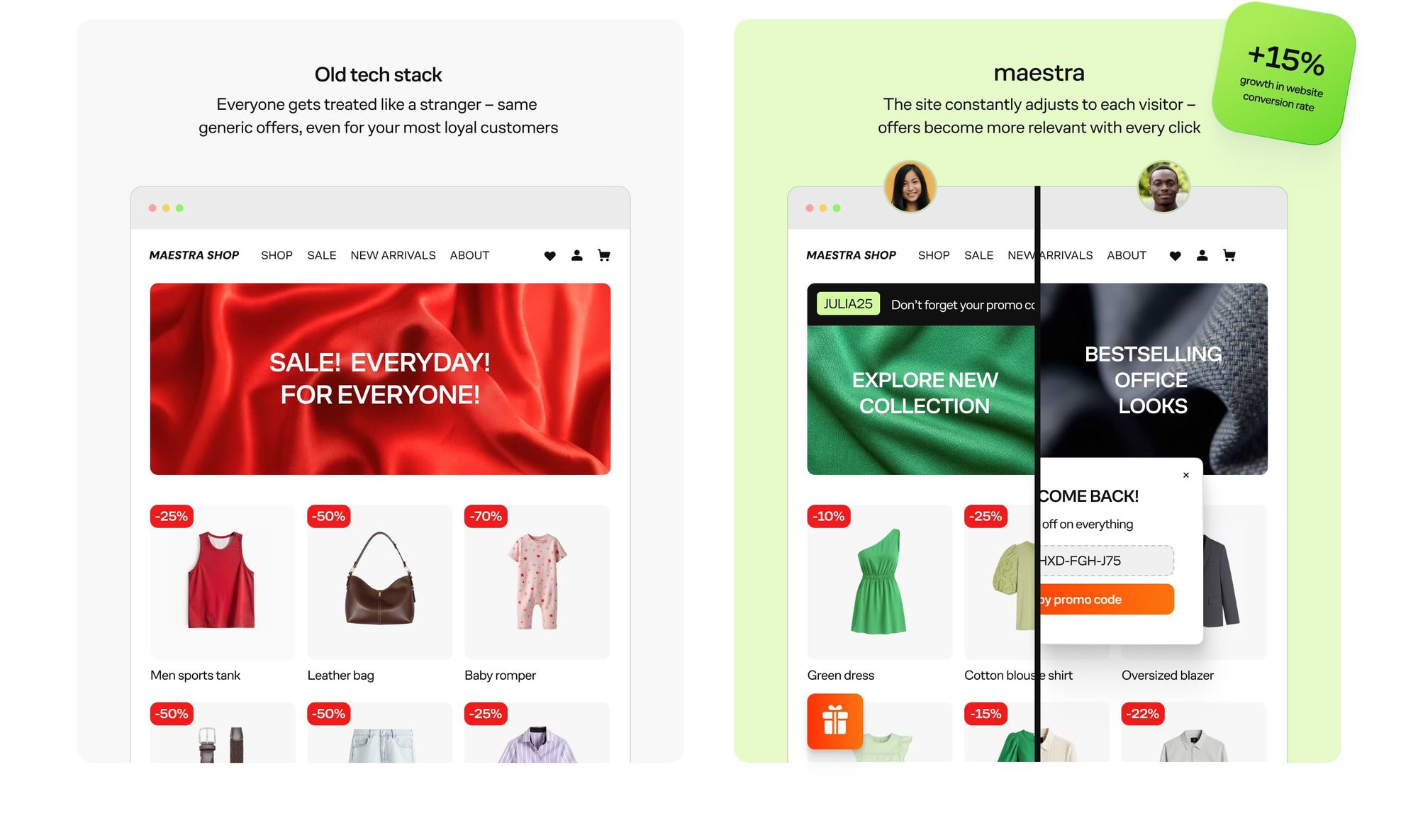
Maestra's real-time CDP feeds recommendations, banners, and pop-ups the same data that powers email and SMS: browsing behavior, purchase history, quiz answers, loyalty status, and session details. The page changes because the customer profile updates, not because someone edited a template.
Outcomes brands report
+56.6%
growth in online revenue year over year after switching from Klaviyo
From a published case study+111.7%
growth in online order volume year over year after switching from Klaviyo
From a published case study49.3%
of active contributors read personalized impact reports, twice the rate of regular emails
From a published case studyCustomer proof
Svaha USA's widgets started suggesting things people also bought

The previous engine had no idea that a dress in sixteen colors is one product. Teaching it real relationships changed both what ends up in the basket and how many items are in it.
 Read the full case study
+34.9%
in items per order
How it works
Your old stack is the safety net
Keep it running
Nothing is switched off at the start. Both setups exist side by side while the new one is proven.
Compare before you commit
You see the rebuilt flows and segments against the ones you know before anything is pointed at customers.
Turn it off on your terms
The old contracts end when you say so, not because the migration forced the date.
The platform
The modules were never meant to be bought separately
Segmentation, messaging, recommendations, and site personalization all read one profile, so a change in any of them is visible to the rest immediately. That is the part a stack of best-of-breed tools cannot reproduce with connectors.
Including
Your forward-deployed marketer
Named, and there next year too
You get one marketer by name who onboards you and stays as the account grows, bringing in deliverability or data specialists when a task needs them. Nobody hands your account to a queue after go-live.
A named marketer, not a pooled team
Specialists pulled in as the work needs them
Stays with the account long-term
Replace your stack
What a fragmented stack costs beyond the invoices
Split data means every question takes an export, and every campaign is built from a partial view. The subscriptions are the visible cost, the missing single profile is the expensive one.
Replaces
Klaviyo
Attentive
Yotpo
Nosto
Bloomreach
What would change on your account
The useful conversation is about your data, your channels, and what a forward-deployed marketer would do in the first month.